
What's in a Private Pay Practice Playbook? A Complete Guide to Building an Insurance-Free Therapy Practice
You decided to go private pay. Maybe you're done fighting with insurance companies. Maybe you want more control over your schedule and your rates. Maybe you're starting fresh and want to skip the panel game entirely.
Whatever brought you here, you've probably noticed: there's no roadmap. Graduate school didn't prepare you for this. Your supervisors were mostly agency or group practice clinicians. The business side of therapy feels like a foreign language.
What you need is a playbook. Not a vague encouragement to "believe in yourself" or an overwhelming list of 47 things you need to do before you can see your first client. A practical, step-by-step guide to building a sustainable private pay practice.
Here's what that playbook should cover—and what each piece actually looks like in practice.
Part 1: The Foundation—Mindset and Money
Before you touch marketing or websites, you need to get clear on two things: what private pay actually means, and what's going on in your head about money.
Private Pay Is a Business Model
Private pay isn't a dream or a luxury. It's a decision about how you want to run your business. That's it.
Some therapists thrive on panels. Some thrive off of them. Neither is morally superior. But if you've chosen private pay, you need to stop treating it like a someday goal and start treating it like the operating model it is.
This means: you're responsible for your own client acquisition. You set your own rates. You build your own reputation. No insurance directory is going to do the work for you.
The Money Mindset Piece
Almost every therapist who struggles with private pay has money stuff to work through. Things like:
"I shouldn't care about money—I'm a helper."
"Charging this much feels greedy."
"Who am I to charge more than [colleague/mentor/random person on the internet]?"
"I haven't earned the right to charge premium rates yet."
A good playbook doesn't skip this. It helps you examine where these beliefs came from, decide whether they're serving you, and build a relationship with money that doesn't sabotage your practice.
Part 2: Setting Your Rate
This is where most therapists get stuck. They either pull a number out of thin air, copy what colleagues charge, or research endlessly and still feel uncertain.
The Math You Actually Need to Do
Your rate isn't about your worth. It's about sustainability. What do you need to charge to:
Cover your business expenses (rent, software, insurance, CEUs, etc.)
Pay yourself a reasonable salary
Save for taxes, retirement, and time off
See a caseload that doesn't burn you out
The formula: (Annual income needed + business expenses + taxes) ÷ (realistic billable sessions per year) = minimum sustainable rate.
Most therapists are shocked when they do this math. The number is almost always higher than what they're currently charging.
Market Research (And Why It Only Matters So Much)
Yes, you should know what other therapists in your area charge. But "the market rate" isn't a ceiling. Private pay clients are choosing you for reasons other than price. Specialization, convenience, personality fit, and reputation all matter more than being the cheapest option.
Your rate should be: high enough to be sustainable, competitive enough to attract clients, and aligned with the value you provide.
Part 3: Your Niche and Positioning
"I help everyone with everything" is not a positioning strategy. It's a recipe for blending into the background.
Why Niching Works
When you specialize, you become the obvious choice for a specific group of people. Instead of being one of 500 therapists in your city, you become "the therapist who works with first-generation professionals navigating family expectations" or "the go-to for men dealing with anger and relationship issues."
Niching doesn't mean you turn away everyone else. It means your marketing speaks directly to someone instead of vaguely to everyone.
Finding Your Niche
Look at:
Who you're already good with (check your caseload—who gets results?)
What training or life experience gives you an edge
What population actually has money for private pay and motivation to seek therapy
What you're genuinely interested in (you'll be talking about this a lot)
A good playbook helps you work through these questions systematically instead of just telling you to "pick a niche."
Part 4: Your Online Presence
You need a website. You probably need a Psychology Today profile. You might benefit from a Google Business Profile and some form of social media presence.
Website Essentials
Your website isn't a brochure—it's a conversion tool. Every page should move the right people toward contacting you and help the wrong people self-select out.
Must-haves:
Clear headline (who you help + what problem you solve)
About page that builds connection and credibility
Services page with your rates (yes, your actual rates)
Easy way to contact you or book a consultation
Nice-to-haves:
Blog content that answers questions your ideal clients are Googling
FAQs addressing common hesitations
Testimonials (if you can get them ethically)
Psychology Today Optimization
Your PT profile is often the first impression. Make it count:
Headline that's specific, not generic
First paragraph that speaks to your ideal client's experience
Personality and warmth in your writing
Clear mention that you're private pay (this filters appropriately)
Google Business Profile
Free, underused, and important for local SEO. Claim it, complete it, and encourage reviews.
Part 5: Getting Clients (Marketing Without Selling Your Soul)
Marketing doesn't have to feel gross. It's just letting the right people know you exist.
The Referral Network
Most successful private pay therapists build their caseloads through referrals—from other therapists, from physicians, from past clients, from adjacent professionals.
A playbook should include specific strategies for:
Identifying who to connect with
How to reach out without being awkward
How to stay top of mind for referrals
How to make yourself easy to refer to
Content and Visibility
Pick a platform. Show up consistently. Create content that helps your ideal clients understand their problems better—without giving away the therapy.
This isn't about going viral. It's about being findable when someone searches for help with exactly what you do.
Part 6: The Consultation and Conversion
Getting inquiries is only half the battle. You also need to convert those inquiries into paying clients.
The Consultation Call
A 15-20 minute call to determine fit. You're assessing them, they're assessing you. Nobody's selling anything—you're both deciding if this is a match.
A playbook should give you:
Scripts for structuring the call
Questions to ask to determine fit
How to discuss rates confidently
How to handle objections or hesitation
How to end the call with clear next steps
Booking and Onboarding
Make it easy. Online scheduling, clear paperwork, payment collection before or at the session. Every point of friction is an opportunity for someone to drop off.
Part 7: Policies and Boundaries
Private pay gives you freedom—including the freedom to create policies that protect your time and energy.
Rate Policies
How do you handle sliding scale? (And do you offer it at all?) What about late cancellations and no-shows? Superbills for out-of-network reimbursement?
A playbook should give you frameworks for thinking through these decisions and scripts for communicating them.
Session Boundaries
How do you handle clients who text between sessions? Who show up late consistently? Who want to extend sessions? Who stop doing the work?
Clear policies, communicated upfront, prevent most problems.
Part 8: Sustainability and Growth
A full caseload isn't the finish line. Sustainability means building a practice you can maintain long-term without burning out.
Raising Rates
You should review your rates annually and raise them every 1-2 years. A playbook includes guidance on how much to raise, how to communicate it, and how to handle pushback.
Scaling or Staying Solo
What does growth look like for you? More clients? Higher rates? Adding groups or workshops? Hiring? Going part-time?
There's no right answer, but a playbook helps you think through the options.
What a Playbook Doesn't Give You
No guide can tell you exactly what your rate should be, who your niche should be, or what marketing platform will work best for you. Those require self-reflection, market awareness, and often some trial and error.
What a good playbook does is give you the frameworks, the questions to ask, and the templates to implement—so you're not starting from scratch.
The Bottom Line
Building a private pay practice isn't complicated, but it does require intentionality. You need to think like a business owner, not just a clinician.
A comprehensive playbook covers the mindset work, the math, the marketing, and the systems—everything you need to go from "I want to be private pay" to "I have a full, sustainable, insurance-free caseload."
You don't have to figure it out alone. But you do have to figure it out.
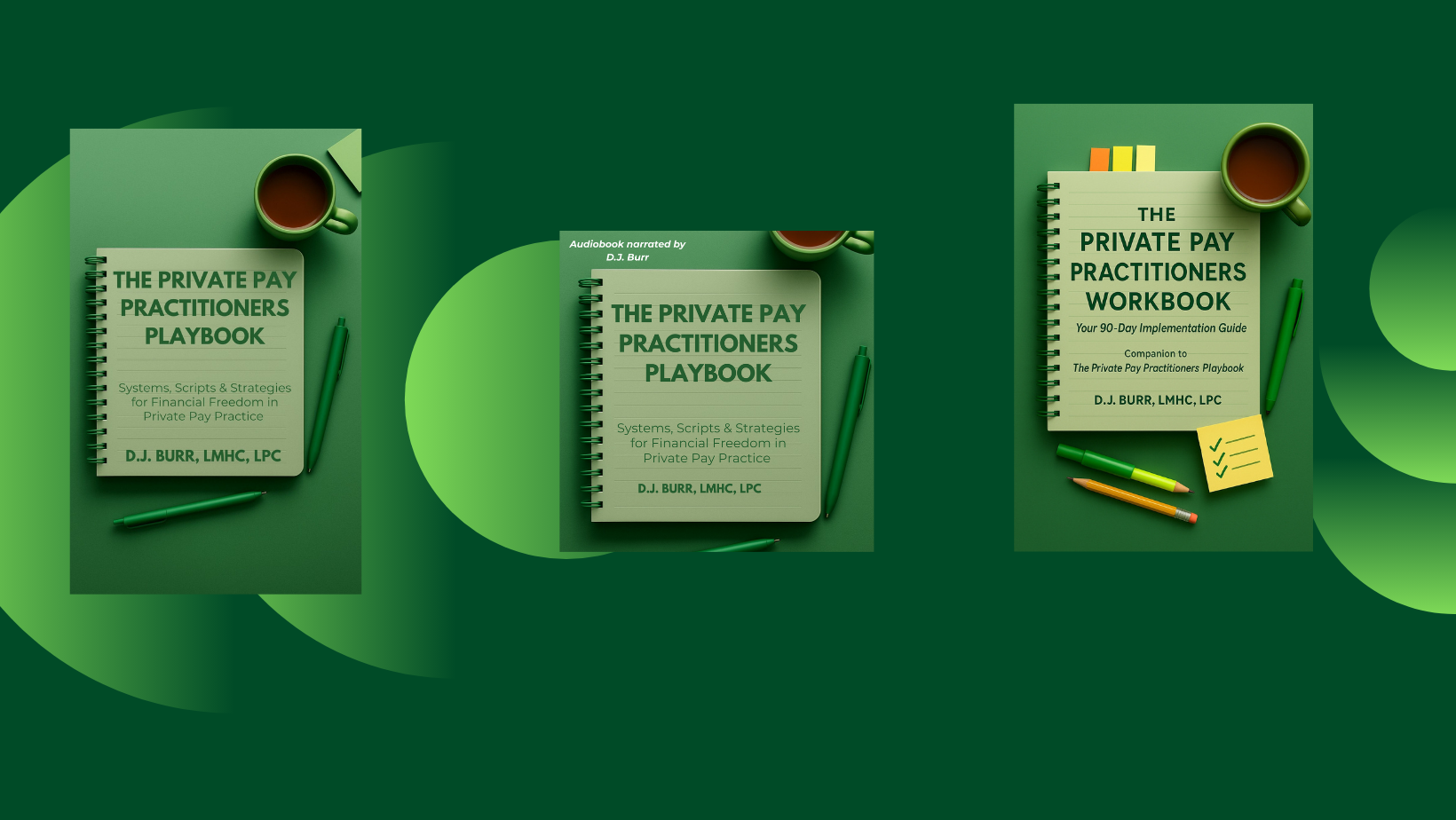
The Private Pay Practitioners Playbook is a step-by-step guide covering everything in this article—and more. Written by a therapist who built a fully private pay practice and now coaches others to do the same. Available on Amazon.