

Why I Started Private Pay Practitioners
The story behind Private Pay Practitioners. A walk in 2016. A friend in money recovery. A meeting that changed everything. And the community that grew from there.
I was walking the AIDS Walk in 2016 when a friend told me about money recovery.
I'd asked her to come with me. We knew each other from another recovery program. I had no idea she was also in money recovery until somewhere along the route, she started telling me about it. The meetings, the steps, the work.
Something cracked open. I said, "I need that."
At the time, ABLE Life Recovery, my practice, was being hammered by insurance companies. Clawbacks. Audits. The kind of thing where you've done the work, you've billed the work, and months later they want the money back. I was in serious debt. Taking out loans to pay my staff. Not paying myself.
I was bleeding out and I knew it. I just didn't know what to do about it. I had a business to run. I owed people what they were owed. So I kept going.
You probably know this feeling.
The Meeting That Changed Everything
I went to my first money recovery meeting the next day.
The first person I met recognized me from my book, I Just Wanted Love. A fellow therapist. The rooms keep showing you what you need to see.
I came in thinking I had a money problem. I left understanding I had a choices problem. I'd been operating like I didn't have any.
Money recovery taught me I had options. About my debt. About how I paid it. About who I talked to about it. It also taught me I had amends to make. Real amends. To family, to friends, to anyone impacted by my not understanding money, by my borrowing, by my difficulty repaying.
I had to take ownership.
For a therapist, that part hits a particular way. We're trained to help other people take ownership of their lives. We're not always great at doing it ourselves. I'd been telling clients about boundaries for years while my own business was a boundary-less mess.
The Bombshell
One of the first things they told me landed like a brick. They said, "Staying on these insurance panels is actually costing you money. It's draining you and your business. This isn't sustainable."
My response: Well, what in the hell am I supposed to do about it?
Being on insurance panels felt necessary. It was how I served clients. The fact that I might not actually get paid for serving those clients was a separate problem. Or so I told myself.
They said, "We think you need to drop the panels."
I was freaking out. I didn't know a single therapist who wasn't on insurance.
The Plan
What I came to love about money recovery was the planning.
Every week, I sat down with people in the program and we reviewed the plan. We talked through the challenges, the stressors, the things that were hard about running a business, paying staff, making it all work.
They weren't all therapists. The one who'd recognized me from my book was, and she helped me. What none of us had in common was a blueprint for what I was doing. Not one person in that group had ever left an insurance panel. What they had was the framework for looking at my finances honestly and building a plan I could actually execute. That mattered more than I understood at the time.
It wasn't a vision board. It was a plan.
Little by little, I started downsizing. I closed the group practice. I transferred my lease to a colleague. I moved my practice into my home and started seeing clients in my den.
A reset. A rightsizing. I wasn't willing to just close up shop and go work at Target. I needed something. And what I held onto, all the way through, was that I had choices. My higher power was with me every step of the way.
Leaving the Panels
One by one, I left the panels. I'd submitted my termination notices months in advance. When the contracts ran out, I was fully private pay.
It was scary. I was afraid of losing clients. I did. Some. Maybe 50%. Others stayed.
I made allowances for reduced rates, temporarily, as I got my grasp. As time went on, more structure surrounded my reduced rates, but only after full-fee clients started coming in. And strategically, I raised rates.
People love to call this kind of thing brave. It wasn't. I had a weekly meeting and a plan and I kept showing up scared. That was the whole thing.
What Came Next
After I went fully private pay, I needed something I didn't have: a community of other private pay practitioners. I didn't know anyone.
Somebody suggested I start a Facebook group. I had familiarity with that. I'd already run a Seattle-based networking group. So in 2017, I created Private Pay Practitioners.
It was just me at first. For about a day. Then people started finding me.
Almost ten years later, the main group has over 17,000 members. There's a Black Private Pay group with more than 500. There's a Georgia chapter with nearly 300 since I moved back from Washington. And there's a Patreon community of clinicians doing the deeper work together.
I didn't build any of that on purpose. I built it because I needed it. Then other people needed it too.
Why This Matters
Every therapist running a private practice deserves a sustainable one. Doesn't matter if you're taking insurance or you've gone private pay.
This matters because the work depends on it. If you spent the morning fighting an insurance company about a clawback from eight months ago, you're not going to be much good to your 2pm client. If your bank account is in a trauma response, you can't do trauma work.
Your nervous system is your clinical instrument. If it's fried, the work suffers. That's not a moral problem. That's mechanics.
My practice didn't get healthy because I read a business book. It got healthy because I went to a meeting. The work you do on yourself shows up in your business. You can't compartmentalize integrity. It either runs through everything or it leaks out everywhere.
If You're Drowning
If you're a therapist who's drowning right now in clawbacks, in debt, in the math of taking insurance, hear me.
You have choices. You may not feel like you do. You may not see them yet. But they're there. The fact that you can't see them is not evidence that they don't exist. It's evidence that you need different eyes on the situation. Other people's. People who've done this before.
And you don't have to figure it out alone. That's the whole reason this community exists. That's why I keep showing up. That's why I'll keep doing this work as long as there's a single private practice clinician who needs to know they're not the only one.
You're not the only one.
Private pay isn't a dream. It's a decision. The same one I had to make in 2016. The same one thousands of therapists have made since.
It's available to you. Come find us.
D.J. Burr, LMHC, LPC
Founder

What I Wish I Had Known Before I Hired a Web Designer
A few years ago I hired TherapyEverywhere to build my website and run my social media. I promoted them. About a year in, I caught them recycling the same content across every client they had. Here's what happened next, and the questions every therapist should ask before signing a contract.
A few years ago, I hired a company to build my therapy practice website and run my social media. They were marketed as therapy-specific; they understood the industry and handled it all. I didn't have to think about hosting, plugins, posting schedules, any of it. That sounded like a dream.
I want to tell you what actually happened, because I think a lot of you are in this position right now and don't know it yet.
About a year in, I started noticing something on social media. Posts I had been told were created for my practice were showing up on other therapists' pages. Same captions, same graphics, same hooks. My name and headshot in some, someone else's name and headshot in others. The "content strategy" I was paying for was a content library being recycled across every client they had.
I felt violated. That is the right word for it. Therapists are taught to lead with authenticity and presence, and I was paying a company to push generic content into the world under my name while telling potential clients it was mine.
So I asked for full control. Not just of my social, but of my website too. They reminded me that there was a fee to take ownership of the site they had built. To get full access to the thing I had been paying for the entire time, I had to pay again.
I pushed back, hard. I made it clear I was prepared to escalate. They eventually gave me access without the fee. I was lucky. Plenty of therapists are not.
But here is the second half of this story. When they handed over the site, it was on WordPress. I had never wanted WordPress. I had told them that. WordPress requires technical familiarity that most clinicians lack, and I am one of them. I now owned a website I could not manage. I ended up paying another company to migrate the whole thing to Squarespace, which is where it lives today.
So I paid for content that was not really mine. I paid to push for the access I should have had from day one. I paid again to move my own site to a platform I could actually use.
That is the part that does not get talked about enough.
What this practice actually looks like
Predatory agency work in our field usually shows up in some combination of these patterns.
The same social media content gets reused across multiple clients. You think you are paying for a custom content strategy. You are paying for a shared library that gets rotated under different names and headshots.
The domain gets registered in the company's name, not yours. The hosting account is in their name. The admin login is theirs. You do not actually own the front door to your own business.
A transfer fee, release fee, or "buyout" gets baked into the contract, sometimes buried in fine print. Leaving costs money. Sometimes a lot of money.
The site gets built on a platform you cannot edit yourself, or on a platform you can edit in theory but were never trained to use. Either way, you are dependent on them indefinitely.
Monthly retainers keep stacking up not because the work requires them, but because you cannot leave without losing access to your accounts, your content, or your audience.
The result is a practice owner who feels stuck, drained, and quietly embarrassed that they did not see it coming. I want to name this clearly. This is not about you being naive. These models are designed to look like care while functioning as a lock.
Questions to ask before you sign anything
If you are about to hire someone to build your site or run your marketing, slow down and ask these out loud. Get the answers in writing.
Whose name will the domain be registered under? Will I have my own login to the domain registrar from day one?
Where will my site be hosted, and will the hosting account be in my name with my login?
Will I have full administrator access to the website itself the entire time you are building and after?
What platform will you build on? Is it a platform I could realistically manage or migrate, or one that requires technical skills I do not have?
If I decide to leave, what does that process look like? Is there a fee? A waiting period? Will you export my site and hand me everything, or will I have to chase you for credentials?
Will the website copy, design, and structure be unique to me? Will my social media content be created for my practice specifically, or are you pulling from a content library used across multiple clients? Can I see examples of two or three other clients' recent posts so I can compare?
Who owns the content you create for me? If we part ways, do I keep it?
Will you train me to update basic things on my own, like adding a blog post or changing my rates, or will I have to come back to you for every change?
If the answer to any of these is vague, defensive, or makes you feel difficult for asking, that is your answer. A good designer or marketer welcomes those questions. They have already built their business around the assumption that you will eventually want to run things yourself.
If you are already stuck
First, take a breath. You are not the only one. I talk to therapists in this exact situation regularly.
Write down what they actually control. Domain registrar. Hosting account. CMS login. Social media account passwords. Email accounts attached to your domain. Analytics. Anything connected to your business identity online. You cannot make a plan until you can see what is being held.
The domain is yours regardless of who registered it for you. ICANN rules protect that. If they are dragging their feet on transferring it, you have options that include a formal domain dispute. You do not have to negotiate from a place of helplessness.
Get any contract you signed in front of a lawyer who works with small business owners. One hour of legal time is worth a lot here. Many release fees are not as enforceable as the company implies, and a short letter from a lawyer changes the conversation fast.
Before you migrate, pick the next platform based on what you can actually manage. Not what is trendy. Not what someone told you was best. Squarespace, Wix, and Showit are easier to manage solo than WordPress for most clinicians. If you go with WordPress, build the cost of an ongoing manager into your budget from day one.
For social media, if you discover you have been getting recycled content, save examples. Take screenshots of the duplicate posts across other client accounts. That documentation matters if you decide to dispute charges, leave a review, or simply protect yourself in future contracts.
The bigger picture
Your website and your social presence are not just marketing assets. They are part of the infrastructure of your practice. The same way you would not let a billing company keep your client records hostage, you cannot let an agency keep your front door, your voice, or your audience hostage either.
You are allowed to ask hard questions. You are allowed to walk away from a quote that does not include clear ownership. You are allowed to take back what is yours.
I lost time and money learning this. I am telling you because I do not want that to be your story too.
If you have already been through some version of this, I would love to hear it. The more we talk about this out loud, the less power these practices have over the next therapist who does not know what to ask.
DJ Burr, LMHC, LPC
Founder, Private Pay Practitioners www.privatepaypractitioners.com

The Myths That Are Keeping You on Insurance Panels Longer Than You Need To Be
If you have been thinking about going private pay -- or you are already there but still second-guessing yourself -- chances are it is not a lack of information holding you back. It is a story. Probably more than one.
I have been working with private pay practitioners long enough to know that the barrier is rarely practical. It is almost always psychological. So let us name the myths out loud, because that is usually the first step to letting them go.
MYTH: No one will pay my full rate.
Someone is paying another therapist in your city full rate right now. The question is not whether clients will pay -- it is whether your messaging is clear enough to attract the ones who will.
One client leaving is not data. It is a data point.
MYTH: I'll lose all my clients if I leave insurance.
You may lose some. But aligned clients often stay, and new ones find you faster than you expect when your messaging finally speaks to the right person.
Feeling like you cannot afford to lose anyone is about scarcity, not strategy. Those are two different conversations.
MYTH: Private pay is only for elite practices.
Private pay means you have a direct, transparent relationship with your clients. That is not elitist. That is sustainable. The broken system is the one paying you $60 for a 53-minute session and calling it adequate.
MYTH: I need to be fully booked before I make the move.
You need a plan, not a full caseload. Waiting until you are fully booked to transition is like waiting until you are out of debt to start saving. The conditions will never feel perfect.
How many times have you said just a few more months?
MYTH: My clients need me too much for me to raise my rates.
That is not a pricing problem. That is a boundary problem wrapped in a clinical relationship. Your clients' financial planning is not your clinical responsibility.
MYTH: I have to accept every client who reaches out.
You are allowed to have a niche. You are allowed to say you are not the right fit. Saying yes to the wrong client means saying no to the right one.
MYTH: Going private pay means I don't care about access to mental health care.
A burned-out, underpaid therapist is not serving anyone well. You can be financially stable and mission-driven. They are not mutually exclusive.
If any of these hit close to home, you are not alone. This is exactly the work we do inside Private Pay Practitioners -- in the Facebook group, on the podcast, and inside our Patreon community every single month.
When you are ready to go deeper, here are three ways to do that:
The Crash Course is a live 3.5-hour session where we work through the real mechanics of building a private pay practice. Early bird pricing ends April 18. Register here: https://luma.com/io4va0y1
One-on-one coaching is available if you want to work through this specifically to your practice, your numbers, and your next move. 50 minutes for $300 or 90 minutes for $400. Book here: https://www.privatepaypractitioners.com
Patreon is where the ongoing support, monthly resources, and community live. If you want to stop doing this alone, that is the place. Join us: patreon.com/privatepay
You built a career worth protecting. Private pay is how you protect it.
DJ Burr, LMHC, LPC
Founder, Private Pay Practitioners

Networking for Therapists Who Hate Networking
“I hate networking” might be the most common thing I hear from therapists.
I get it. The word conjures images of awkward mixers, forced small talk, and collecting business cards from people you’ll never contact. That’s not what I’m talking about.
Networking for therapists is simpler: build genuine relationships with people who might refer to you or collaborate with you. That’s it.
Why it matters more than advertising.
A referral from a trusted source is worth more than a hundred website clicks.
When a psychiatrist tells their patient “I know someone perfect for you,” that patient arrives already trusting you. When a fellow therapist says “I don’t work with couples, but my colleague does and she’s great,” that referral is practically a closed deal.
You can’t buy that. You have to build it.
Start with who you know.
You don’t need to cold-call strangers. Start with people you already have some connection to: former classmates or training cohort members, therapists whose work you admire, professionals you’ve interacted with (doctors, lawyers, school counselors), and people you’ve met at trainings or workshops.
Make a list of 20 people. That’s your starting network.
The coffee meeting.
The simplest networking move: invite someone for coffee (or a Zoom call). Not to pitch yourself. To learn about them and see if there’s natural connection.
“Hey [name], I’ve been trying to connect with other therapists in the area and I’d love to hear about your practice. Would you be up for a 30-minute coffee sometime?”
That’s it. No agenda beyond genuine curiosity.
Follow up and stay connected.
Here’s where most people drop the ball. They have the coffee meeting and then… nothing.
Networking isn’t a one-time event. It’s maintaining relationships over time.
Send a quick email after you meet: “Great to connect - I’ll definitely keep you in mind for [whatever they mentioned].”
Be a good referral source and you’ll become one.
How much networking is enough?
I recommend two networking activities per month. That’s it. Not two per week - two per month.
Small, consistent effort beats occasional frantic activity.
For introverts.
If large events drain you, skip them. One-on-one coffee meetings are often more effective anyway.
If small talk is painful, remember: you’re a therapist. You’re literally trained to ask good questions and listen deeply. Use those skills.
Networking isn’t about being extroverted. It’s about being intentional.
The Networking Toolkit has scripts, templates, and a tracker to make this easy: https://privatepaypractitioners.com/services

The Consultation Call Mistakes I Watch Therapists Make Over and Over
Consult calls are one of the most common places I watch therapists sabotage their private pay practice without realizing it.
You do everything right on the front end. You update your website. You clarify your niche. You get in front of the right people on Facebook or Instagram. Someone finally reaches out, books a consultation, and you get on the call feeling hopeful. Then you get off the call and they don't book.
You start wondering if it's your rate. It's usually not your rate.
It's usually the call itself.
The Bigger Frame
Before I get into specific mistakes, here's the shift I want you to make. A consultation call is not a mini-therapy session. It's not an interview where you're being evaluated. It's a conversation with one purpose: determine if you two are a fit.
That's it. You're not there to prove yourself. You're not there to build rapport by giving them free therapy. You're there to figure out if you can help them, if they're ready to be helped, and whether the logistics work.
When you keep that frame, the mistakes below stop happening naturally. When you don't, you make them all.
Mistake 1: Turning the call into a mini-therapy session
I see this constantly. The consult call goes 45 minutes. The therapist listens deeply, reflects skillfully, offers observations. The potential client feels seen and heard.
Then they don't book. Because they already got what they came for.
If you give someone the emotional experience of therapy for free, they no longer need to pay for it. Not consciously. But the urgency drops. The problem feels a little smaller. They think "let me sit with this for a while." And then you never hear from them again.
Fifteen minutes. That's the ceiling. If you can't determine fit in fifteen minutes, you probably can't determine it at all.
Mistake 2: Launching into a monologue about your approach
When someone asks "what's your approach?" they are not asking you to explain CBT versus psychodynamic therapy. They are asking, in different words, "can you help me?"
If you spend five minutes describing your modalities, you have answered a question they didn't ask. You've also lost them, because most people don't care about the mechanics. They care about the outcome.
Try this instead. Describe what working with you actually looks like and where it tends to lead. Something like: "The people I work with usually come in feeling stuck in the same pattern they've been repeating for years. Over the course of our work, they get clearer about what's actually driving it and start to have real choices in the moments that used to run them. I'm pretty direct. I'll name what I see."
That's what they're actually asking about.
Mistake 3: Apologizing for your rate
The rate conversation is where most of the damage happens.
Watch how you state your rate the next time you have a consult call. Do you offer it flatly? Or do you soften it, hedge it, explain it, or immediately follow it with "but I can offer a sliding scale"?
If you can't say your rate out loud without flinching, your rate is probably too low for what you need. Fix the rate first. Then practice saying it flat.
The script is: "My rate is $X per session. I don't bill insurance directly, but I can provide a superbill if you'd like to submit for out-of-network reimbursement."
Then stop talking. Let them respond. Do not fill the silence.
Mistake 4: Forgetting you're evaluating them too
The consult call is not just about them deciding if they want to work with you. You're deciding if you want to work with them.
Do they seem ready to do the work, or are they hoping you'll fix them? Are they respectful of your time and rate, or already negotiating? Do their expectations align with what you actually offer?
You get to say no. If someone doesn't feel like the right fit, you can end the call with, "Based on what you've shared, I think you might be better served by someone who specializes in [X]. I'd be happy to send some referrals your way."
Not every inquiry should become a client. Your caseload is not a numbers game. It's a curated group of people you can actually help.
Mistake 5: Doing free consults after you have a clear niche
Here's my actual position on this. Free consultations make sense when you're still refining your niche, your messaging, and your ideal client. You need the reps. You need to hear how people describe their problems in their own words. Free consults are training data.
Once your niche is clear and your messaging is doing the screening for you, free consults become obsolete. The people reaching out already know who you are, what you do, and what you charge. They're not asking whether you're the right therapist. They're asking when you can start.
At that point, the free consult is just free labor. You either drop it entirely and let people book directly, or you move to a paid consultation model where anyone who wants a conversation before booking pays for that time.
Most of the therapists I coach transition out of free consults once they've done the niche work. Their conversion rates go up. Their calendars stop getting cluttered with tire-kickers. And the people who do reach out are already sold.
What Success Looks Like
A consult call that works is short, direct, and clear on both sides. You know if you can help them. They know if they want to hire you. The next step is scheduling a first session, or you both agree it's not a fit and part ways.
You don't leave feeling drained. They don't leave feeling like they got a free therapy session. Both of you know what happened and what's next.
That's the outcome you're building toward. Everything else is friction.
Where to Start
If you're struggling with consult calls, work backward. Look at your niche and messaging first. If those are unclear, no consult call script is going to fix your conversion rate. Fix the front end, then the back end starts working.
If your niche is clear and consults still aren't converting, record yourself on a call. Listen to your rate delivery. Time the length. Notice when you're doing therapy versus when you're assessing fit. The mistakes are usually in specific moments you can hear if you're willing to listen.
If you want structured support with this, I offer strategy calls and a 6-week intensive specifically for therapists building sustainable private pay practices. My "So You Want To Be Private Pay" course walks through consultation scripts in detail. Both are available at privatepaypractitioners.com.
You get to have consult calls that work. You just have to stop treating them like something they aren't.
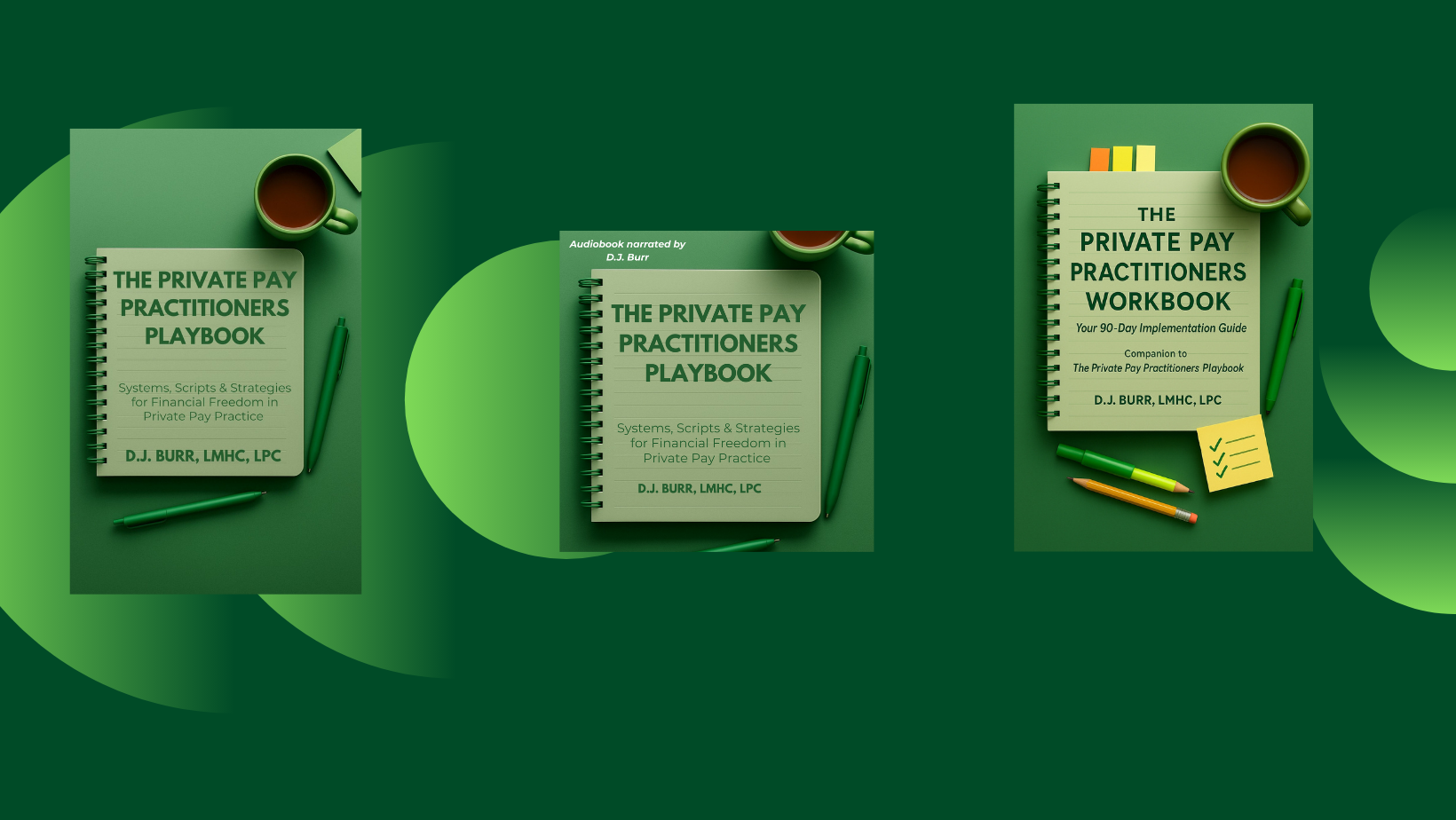
What's in a Private Pay Practice Playbook? A Complete Guide to Building an Insurance-Free Therapy Practice
You decided to go private pay. Maybe you're done fighting with insurance companies. Maybe you want more control over your schedule and your rates. Maybe you're starting fresh and want to skip the panel game entirely.
Whatever brought you here, you've probably noticed: there's no roadmap. Graduate school didn't prepare you for this. Your supervisors were mostly agency or group practice clinicians. The business side of therapy feels like a foreign language.
What you need is a playbook. Not a vague encouragement to "believe in yourself" or an overwhelming list of 47 things you need to do before you can see your first client. A practical, step-by-step guide to building a sustainable private pay practice.
Here's what that playbook should cover—and what each piece actually looks like in practice.
Part 1: The Foundation—Mindset and Money
Before you touch marketing or websites, you need to get clear on two things: what private pay actually means, and what's going on in your head about money.
Private Pay Is a Business Model
Private pay isn't a dream or a luxury. It's a decision about how you want to run your business. That's it.
Some therapists thrive on panels. Some thrive off of them. Neither is morally superior. But if you've chosen private pay, you need to stop treating it like a someday goal and start treating it like the operating model it is.
This means: you're responsible for your own client acquisition. You set your own rates. You build your own reputation. No insurance directory is going to do the work for you.
The Money Mindset Piece
Almost every therapist who struggles with private pay has money stuff to work through. Things like:
"I shouldn't care about money—I'm a helper."
"Charging this much feels greedy."
"Who am I to charge more than [colleague/mentor/random person on the internet]?"
"I haven't earned the right to charge premium rates yet."
A good playbook doesn't skip this. It helps you examine where these beliefs came from, decide whether they're serving you, and build a relationship with money that doesn't sabotage your practice.
Part 2: Setting Your Rate
This is where most therapists get stuck. They either pull a number out of thin air, copy what colleagues charge, or research endlessly and still feel uncertain.
The Math You Actually Need to Do
Your rate isn't about your worth. It's about sustainability. What do you need to charge to:
Cover your business expenses (rent, software, insurance, CEUs, etc.)
Pay yourself a reasonable salary
Save for taxes, retirement, and time off
See a caseload that doesn't burn you out
The formula: (Annual income needed + business expenses + taxes) ÷ (realistic billable sessions per year) = minimum sustainable rate.
Most therapists are shocked when they do this math. The number is almost always higher than what they're currently charging.
Market Research (And Why It Only Matters So Much)
Yes, you should know what other therapists in your area charge. But "the market rate" isn't a ceiling. Private pay clients are choosing you for reasons other than price. Specialization, convenience, personality fit, and reputation all matter more than being the cheapest option.
Your rate should be: high enough to be sustainable, competitive enough to attract clients, and aligned with the value you provide.
Part 3: Your Niche and Positioning
"I help everyone with everything" is not a positioning strategy. It's a recipe for blending into the background.
Why Niching Works
When you specialize, you become the obvious choice for a specific group of people. Instead of being one of 500 therapists in your city, you become "the therapist who works with first-generation professionals navigating family expectations" or "the go-to for men dealing with anger and relationship issues."
Niching doesn't mean you turn away everyone else. It means your marketing speaks directly to someone instead of vaguely to everyone.
Finding Your Niche
Look at:
Who you're already good with (check your caseload—who gets results?)
What training or life experience gives you an edge
What population actually has money for private pay and motivation to seek therapy
What you're genuinely interested in (you'll be talking about this a lot)
A good playbook helps you work through these questions systematically instead of just telling you to "pick a niche."
Part 4: Your Online Presence
You need a website. You probably need a Psychology Today profile. You might benefit from a Google Business Profile and some form of social media presence.
Website Essentials
Your website isn't a brochure—it's a conversion tool. Every page should move the right people toward contacting you and help the wrong people self-select out.
Must-haves:
Clear headline (who you help + what problem you solve)
About page that builds connection and credibility
Services page with your rates (yes, your actual rates)
Easy way to contact you or book a consultation
Nice-to-haves:
Blog content that answers questions your ideal clients are Googling
FAQs addressing common hesitations
Testimonials (if you can get them ethically)
Psychology Today Optimization
Your PT profile is often the first impression. Make it count:
Headline that's specific, not generic
First paragraph that speaks to your ideal client's experience
Personality and warmth in your writing
Clear mention that you're private pay (this filters appropriately)
Google Business Profile
Free, underused, and important for local SEO. Claim it, complete it, and encourage reviews.
Part 5: Getting Clients (Marketing Without Selling Your Soul)
Marketing doesn't have to feel gross. It's just letting the right people know you exist.
The Referral Network
Most successful private pay therapists build their caseloads through referrals—from other therapists, from physicians, from past clients, from adjacent professionals.
A playbook should include specific strategies for:
Identifying who to connect with
How to reach out without being awkward
How to stay top of mind for referrals
How to make yourself easy to refer to
Content and Visibility
Pick a platform. Show up consistently. Create content that helps your ideal clients understand their problems better—without giving away the therapy.
This isn't about going viral. It's about being findable when someone searches for help with exactly what you do.
Part 6: The Consultation and Conversion
Getting inquiries is only half the battle. You also need to convert those inquiries into paying clients.
The Consultation Call
A 15-20 minute call to determine fit. You're assessing them, they're assessing you. Nobody's selling anything—you're both deciding if this is a match.
A playbook should give you:
Scripts for structuring the call
Questions to ask to determine fit
How to discuss rates confidently
How to handle objections or hesitation
How to end the call with clear next steps
Booking and Onboarding
Make it easy. Online scheduling, clear paperwork, payment collection before or at the session. Every point of friction is an opportunity for someone to drop off.
Part 7: Policies and Boundaries
Private pay gives you freedom—including the freedom to create policies that protect your time and energy.
Rate Policies
How do you handle sliding scale? (And do you offer it at all?) What about late cancellations and no-shows? Superbills for out-of-network reimbursement?
A playbook should give you frameworks for thinking through these decisions and scripts for communicating them.
Session Boundaries
How do you handle clients who text between sessions? Who show up late consistently? Who want to extend sessions? Who stop doing the work?
Clear policies, communicated upfront, prevent most problems.
Part 8: Sustainability and Growth
A full caseload isn't the finish line. Sustainability means building a practice you can maintain long-term without burning out.
Raising Rates
You should review your rates annually and raise them every 1-2 years. A playbook includes guidance on how much to raise, how to communicate it, and how to handle pushback.
Scaling or Staying Solo
What does growth look like for you? More clients? Higher rates? Adding groups or workshops? Hiring? Going part-time?
There's no right answer, but a playbook helps you think through the options.
What a Playbook Doesn't Give You
No guide can tell you exactly what your rate should be, who your niche should be, or what marketing platform will work best for you. Those require self-reflection, market awareness, and often some trial and error.
What a good playbook does is give you the frameworks, the questions to ask, and the templates to implement—so you're not starting from scratch.
The Bottom Line
Building a private pay practice isn't complicated, but it does require intentionality. You need to think like a business owner, not just a clinician.
A comprehensive playbook covers the mindset work, the math, the marketing, and the systems—everything you need to go from "I want to be private pay" to "I have a full, sustainable, insurance-free caseload."
You don't have to figure it out alone. But you do have to figure it out.
The Private Pay Practitioners Playbook is a step-by-step guide covering everything in this article—and more. Written by a therapist who built a fully private pay practice and now coaches others to do the same. Available on Amazon.

Why Every Private Pay Therapist Needs a Professional Community (And How to Find the Right One)
Going private pay can feel like stepping off a cliff. You're leaving the predictable (if frustrating) world of insurance panels for something that feels riskier, lonelier, and full of questions nobody in your grad program prepared you to answer.
Questions like: How do I actually get clients without insurance directories? What do I say when someone asks for a superbill? Is $150 too much? Too little? Why does everyone else seem to have this figured out?
Here's what most therapists discover eventually: the ones who succeed in private pay aren't doing it alone. They've found their people.
The Isolation Problem
Private practice is already isolating. Add "private pay" to the mix and it gets worse.
Your insurance-based colleagues don't get it. They're worried about credentialing delays and reimbursement rates. You're worried about whether anyone will pay out-of-pocket at all.
Your friends and family definitely don't get it. ("You're charging HOW much per hour? And people just... pay that?")
And the internet? It's full of contradictory advice from people selling $5,000 courses on how to build a six-figure practice in six months.
You need people who are in it with you. People who understand that this is hard AND possible. People who've been where you are and can tell you what actually works.
What a Good Community Offers
Normalization. The fears you have? Everyone has them. The mistakes you're making? Everyone made them. Hearing "I went through that too" is worth more than any marketing course.
Real answers from real practitioners. Not theory. Not what should work according to some business coach who's never seen a client. Actual "here's what I did and here's what happened" information.
Accountability without judgment. Someone to ask "Did you raise your rates yet?" without making you feel like garbage if the answer is no.
Referrals and connections. Other private pay therapists aren't your competition. They're your referral network. They're full, you're not, they send someone your way. You specialize in trauma, they specialize in couples, you trade referrals. This is how sustainable practices get built.
Permission. Sometimes you just need someone further along to say, "Yes, you can charge that," or "Yes, you can say no to that client," or "Yes, you can take a vacation."
What to Look For (And Avoid)
Look for:
Communities specifically focused on private pay (not just "therapist entrepreneurs" or "private practice" generally—the private pay piece matters)
Active engagement, not just promotional posts
Mix of experience levels (people ahead of you AND people behind you)
Clear moderation and culture of support over competition
Free or low-cost options to start (you shouldn't have to pay hundreds to find your people)
Avoid:
Communities that are mostly people selling to each other
Spaces where every question gets answered with "buy my course"
Groups with no moderation where bad advice goes unchecked
Anywhere that makes you feel worse about where you are instead of better
Where to Find Your People
Facebook Groups: Still the largest concentration of therapist communities. Search for "private pay therapists," "cash pay therapy," or "insurance-free practice." Look at member count, post frequency, and whether the posts are actual discussions or just self-promotion.
Professional associations: Some have private pay or practice-building special interest groups. Check NASW, ACA, AAMFT, or your state association.
Local networking: Sometimes the best community is five therapists in your city who meet for coffee once a month. Don't underestimate proximity.
Online memberships: Some coaches and consultants run ongoing communities as part of their offerings. These can be valuable if the leader has real experience and the culture is collaborative, not competitive.
The Real Value
Here's what nobody tells you about community: it's not just about getting answers. It's about staying in the game long enough to figure it out.
Private pay has a learning curve. There will be months where you doubt everything. There will be moments where going back to panels feels easier than pushing forward.
The therapists who make it aren't necessarily smarter or better at marketing. They're the ones who had someone in their corner saying "keep going" when it got hard.
Find your people. It matters more than any strategy.
Looking for a community of private pay practitioners? Private Pay Practitioners is a free Facebook community of over 16,000 therapists navigating the transition from insurance to private pay. No gatekeeping, no pressure, just real support from people who get it.

Before You Say Yes to That "Opportunity": 3 Questions to Ask Yourself
Therapists get asked to do free or low-cost work constantly. Speak at this event. Contribute to this project. Join this panel. Write this article.
And because we're helpers by nature, our default is yes. We want to give. We want to be generous. We want to "get our name out there."
But not every opportunity is actually an opportunity. Some of them are just obligations dressed up in networking clothes.
Here's what I want you to consider the next time one of these requests lands in your inbox.
1. Is this in alignment with my personal and professional values?
Not "does this sound good on paper" or "would this impress people" - but does this actually align with what matters to YOU?
If you value family time and this event is on a Saturday, that's a conflict. If you value financial sustainability and this opportunity pays nothing while costing you money, that's a conflict. If you value working with a specific population and this audience is completely outside your niche, that's a conflict.
Values alignment isn't a nice-to-have. It's the filter.
2. Will my ideal clients potentially benefit from what I'm going to share - even if none of them schedule with me?
This is the generosity check. Sometimes we do things not because they'll directly bring us clients, but because the content genuinely helps people we care about helping.
That's valid. That's service.
But be honest: Is YOUR ideal client in that room (or reading that article, or listening to that podcast)? Or are you saying yes because you feel obligated, flattered, or guilty?
If your ideal clients will never see it and it won't serve your actual mission, it's not generosity. It's people-pleasing.
3. Will this cause me undue stress - mentally, spiritually, or financially? Will I have to compromise my stability to make it make sense?
This is the one we skip. We tell ourselves we can "make it work." We minimize the cost - financial and otherwise.
But if saying yes means:
Losing income from canceled client sessions
Paying out of pocket for travel or materials
Adding stress to an already full plate
Resenting the commitment before it even happens
...then you're not being generous. You're self-abandoning.
Sustainability isn't selfish. You cannot pour from an empty practice.
The Bottom Line
These three questions won't tell you what to do. But they'll help you make a decision you can live with - one that's actually yours, not driven by guilt, obligation, or the fear of missing out.
And here's what most people won't say out loud: On occasion, when I decide to do something for free, it's usually my idea.
That changes everything.
What's your filter for evaluating "opportunities"? I'd love to hear what works for you.
D.J. Burr, LMHC, LPC

What Your Website Homepage Should Actually Say
Your homepage has one job: help the right person understand that you can help them, and show them what to do next.
That’s it. Not impress them with your credentials. Not explain your entire therapeutic philosophy. Not list every service you’ve ever offered.
When someone lands on your homepage, they’re asking three questions: Is this person for me? Can they help with my problem? What do I do next?
If your homepage doesn’t answer those questions in the first few seconds, they’re gone.
The hero section.
The top of your homepage - what people see before they scroll - is prime real estate. Most therapists waste it.
What I see constantly: a stock photo of stacked rocks, the therapist’s name in giant letters, and a tagline like “Healing Starts Here” or “Begin Your Journey.”
That tells a potential client nothing.
Instead, your hero section should include: A headline that speaks directly to your ideal client’s pain or desire. A subheadline that hints at transformation. A clear call-to-action button.
Example: Headline: “Exhausted by anxiety that won’t quit?” Subheadline: “Therapy for high-achievers who are tired of white-knuckling through life.” Button: “Schedule a free consultation”
In five seconds, someone knows if this is for them.
Stop leading with credentials.
I know you worked hard for those letters after your name. But “Jane Smith, LMFT, LPC, NCC, EMDR-Certified” means nothing to someone who just Googled “therapist for relationship issues.”
Your credentials matter - but they’re not the headline. Put them in your about page or footer. Lead with what you do for people.
Services - keep it simple.
If you offer individual therapy, list it. If you offer couples, list it. If you offer intensives, list them.
Don’t make people hunt for what you offer or how to work with you. And don’t list 15 different specialized services unless you genuinely want to fill your calendar with all 15.
The call-to-action.
Every section of your homepage should point toward one thing: getting them to take the next step.
That might be “Schedule a consultation.” It might be “Send me a message.” Whatever it is, make it clear and repeat it multiple times throughout the page.
Don’t make people scroll to the bottom and search for how to contact you. The button should be visible constantly.
A note on design.
You don’t need a fancy website. You need a clear one.
Clean, readable font. Enough white space. A photo of you (yes, a real photo - not a logo). Easy navigation.
Squarespace, Wix, or any simple platform is fine. A confused user on a gorgeous website will still leave.
The Playbook has a full chapter on website copy that converts. Grab it here: https://a.co/d/g6bBKPZ

Your Psychology Today Profile is Costing You Clients
When someone types their zip code into Psychology Today, they get a wall of therapists. Rows and rows of faces with four lines of text underneath each one.
Four lines. That's what you get before they scroll past you.
If your first line is "Hello! My name is..." or "I am a Licensed Professional Counselor with 10 years of experience..." you've already lost them. You sound like everyone else. And when everyone sounds the same, people pick based on convenience or cost - not fit.
Your first line is your niche statement.
The very first sentence of your profile should tell your ideal client exactly who you help. Not your credentials. Not your modalities. Not a greeting. Your niche.
I just searched a random Atlanta zip code. Here's what I saw over and over:
"Hello! My name is [name] and I am a licensed therapist in the state of Georgia..."
"I am a Licensed Professional Counselor with a Master's degree in..."
"Welcome! I'm [name], a passionate and dedicated therapist committed to fostering growth..."
"Congratulations! You just made an important step in the change process..."
None of these tell me who they help. None of these make me stop scrolling.
Now compare to this:
"I help high-achieving women navigate life stressors and mental health concerns."
"I specialize in working with big-hearted people-pleasers who want to move beyond limiting patterns of self-doubt, fear, and overthinking."
"Therapy for new moms who feel like they're failing at everything."
Those make the right person stop. Those make someone think "wait - that's me."
The four-line test.
Before you do anything else, go look at your profile the way a potential client sees it. Search your zip code. Find yourself in the list. Look at those four lines.
Do they tell someone who you help? Do they speak to the client's experience? Or do they talk about you?
If your four lines are about your credentials, your training, your years of experience, or your therapeutic approach - rewrite them.
Speak to them, not about you.
Your ideal client isn't searching for a therapist thinking "I hope I find someone with a Master's degree from a good school who uses an integrative approach combining CBT and mindfulness."
They're thinking "I'm exhausted. I'm anxious. I don't know what's wrong with me. I need someone who gets it."
Write to that person.
Instead of: "I am a licensed therapist with 15 years of experience specializing in anxiety and depression."
Try: "You're exhausted from holding everything together. The anxiety never stops, even when everything looks fine from the outside."
The first one is a resume. The second one is a mirror.
What to cut.
Your full name in the first line (it's already at the top of the profile). Your credentials in the first paragraph (save them for later). Long lists of modalities (clients don't know what these mean). Generic phrases like "warm and supportive environment" or "meet you where you are." Anything that could be copied and pasted onto another therapist's profile.
What your first four lines should include.
Line 1: Who you help (your niche statement). Lines 2-4: What they're experiencing and what's possible.
That's it. You have maybe 10 seconds before they scroll. Use those seconds to make the right person feel seen.
The rest of the profile.
Once you've hooked them with the first four lines, then you can talk about your approach, your background, what makes you different. But none of that matters if they never click through to read it.
The issues and specialties checkboxes matter too - don't check 30 boxes. Pick the ones that genuinely reflect who you want to work with. Every box you check dilutes your message.
Test it.
Search your zip code. Look at your profile next to everyone else's. Would you click on you? Does anything make you stand out?
If not, rewrite your first line today. Make it your niche statement. Make it about them.
Join the Patreon community for profile reviews, marketing feedback, and weekly support: https://patreon.com/privatepay

Advertising, Marketing, and Networking: They’re Not the Same Thing
It All Begins Here
Therapists use these words interchangeably all the time. “I need to do more marketing,” when they mean advertising. “My advertising isn’t working,” when the problem is actually their messaging. “I hate marketing,” when what they really hate is self-promotion.
Let’s untangle this.
Marketing is the umbrella.
Marketing is everything about how you position yourself and communicate your value. It’s your messaging, your brand, who you’re trying to reach, and how you talk about what you do. Marketing answers the questions: Who do I help? What problem do I solve? Why should someone choose me?
Your website copy is marketing. Your Psychology Today profile is marketing. The way you describe your practice at a networking event is marketing. The Instagram post you wrote about burnout is marketing.
Marketing isn’t something you do - it’s the foundation everything else sits on.
Advertising is paid visibility.
Advertising is when you pay to put your message in front of people. Psychology Today is advertising (yes, that monthly fee is an ad). Google Ads, Facebook Ads, Instagram promotions, sponsored posts - all advertising.
Here’s where therapists get tripped up: they invest in advertising before their marketing is solid. You can pay for all the visibility in the world, but if your messaging doesn’t resonate, you’re just paying to be ignored.
I’ve seen therapists spend hundreds on Google Ads driving traffic to a website that says, “I provide a warm, supportive environment using evidence-based approaches.” That’s not a message. That’s wallpaper.
Networking is relationship-based visibility.
Networking is building connections with people who can refer to you or collaborate with you. Coffee meetings with other therapists, connecting with physicians, building relationships with school counselors, and joining professional communities.
Networking is slow. It doesn’t scale. And it’s often the most effective thing you can do.
Why? Because a referral from a trusted source carries weight that no ad can match. When a psychiatrist tells their patient “I know a therapist who specializes in exactly what you’re dealing with,” that person is practically sold before they ever visit your website.
So what does this mean for your practice?
First, get your marketing right. Clarify who you help and what transformation you provide. Make sure your website and profiles actually speak to your ideal client’s experience - not just your credentials and modalities.
Second, don’t over-rely on any single advertising channel. I’ve watched therapists build entire practices on Psychology Today referrals, then panic when the algorithm changes or their area gets saturated. Diversify. Maybe it’s Psychology Today, a Google Business Profile, and one other directory. Don’t put all your eggs in one basket.
Third, network consistently. Not frantically when your caseload drops - consistently. Two coffee meetings a month. Staying connected with colleagues. Building real relationships, not just collecting business cards.
Here’s the thing: advertising costs money. Networking costs time. But bad marketing costs you both - because you’ll spend money on ads that don’t convert and time on networking conversations that don’t lead anywhere, all because your message isn’t landing.
Before you ask, “Where should I advertise?” ask, “Is my message clear?” Before you ask, “How do I get more referrals?” ask, “Do people actually understand who I help?”
Marketing first. Then decide how you want to get visible - through paid advertising, relationship-building, or ideally both.
Not sure what to charge? Start with the Private Pay Rate Calculator to get your numbers clear.

Why “I Work With Anxiety and Depression” Isn’t A Niche
If your answer to “who do you work with?” is “I work with anxiety and depression,” you don’t have a niche. You have a description of 80% of therapy clients.
I know this feels controversial. You went to school to help people with mental health issues. Anxiety and depression are mental health issues. Why wouldn’t you list them?
Because when everyone says the same thing, no one stands out. And when no one stands out, clients pick based on convenience or cost - not fit.
What a niche actually is.
A niche isn’t just a diagnosis or population. It’s a specific person with a specific problem at a specific point in their life.
Compare these:
“I work with anxiety.”
vs.
“I work with high-achieving women in their 30s who look like they have it all together but are secretly exhausted by their own perfectionism.”
The first one describes a symptom. The second one describes a human being. Which one would you click on if you were that woman?
The specificity objection.
“But if I get too specific, I’ll turn people away!”
Maybe. But you’ll also attract the right people - the ones who read your website and think “it’s like they’re describing my life.”
Here’s what actually happens when you niche down: You become memorable. Referral sources think of you for specific situations. Your marketing becomes easier because you know exactly who you’re talking to. And counterintuitively, you often get more inquiries, not fewer.
I’d rather have 10 inquiries from people who are genuinely a great fit than 50 inquiries from people who picked me because I was available on Tuesdays.
How to find your niche.
Start with energy, not strategy.
Who do you love working with? Not who can you work with - who lights you up? Who do you think about between sessions because you’re genuinely invested in their progress?
Now flip it: Who drains you? Who do you dread seeing on your schedule? What types of clients leave you feeling depleted?
The patterns there will tell you more than any market research.
Then ask: What do I bring that’s different? Maybe it’s lived experience. Maybe it’s a specific training. Maybe it’s your style or approach. Your niche lives at the intersection of who you love working with and what makes you uniquely suited to help them.
The “I help” statement.
Try this formula: I help [specific person] who is struggling with [specific problem] so they can [specific transformation].
Not: “I help adults with anxiety and depression.”
Instead: “I help new moms who feel like they’re failing at everything rebuild their confidence and actually enjoy motherhood.”
The first is forgettable. The second makes the right person feel seen.
The Playbook walks you through finding your niche step by step. Grab it here: https://a.co/d/g6bBKPZ